


Visit to Shaktipeeth Complex

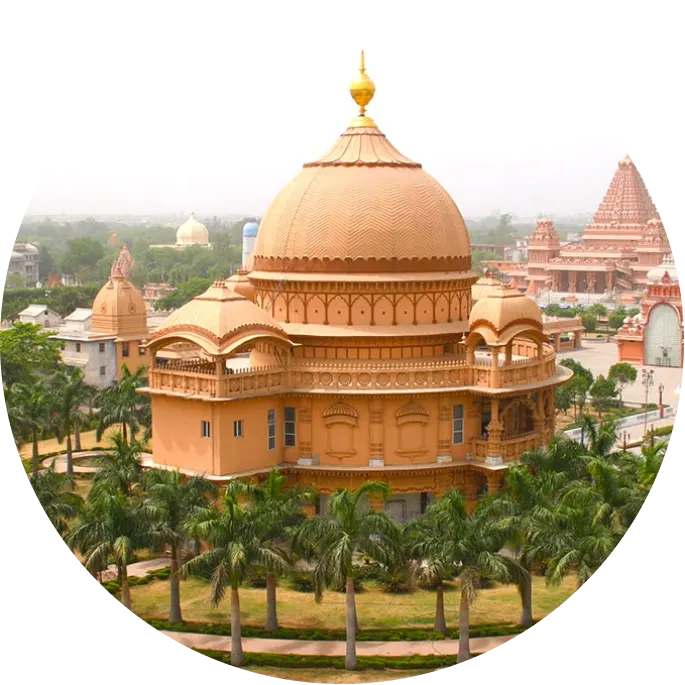
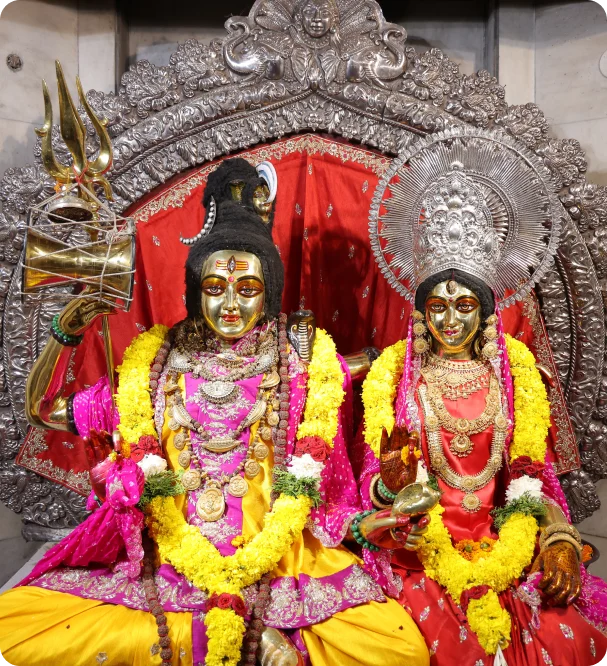
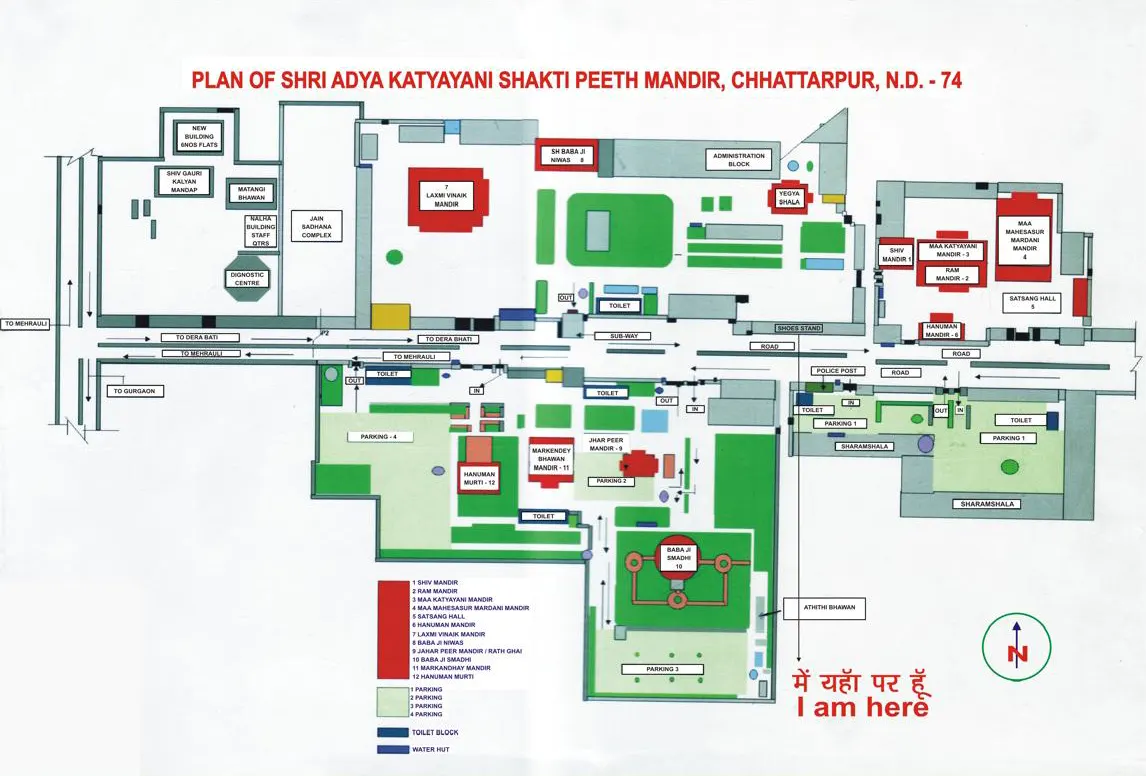
Visitors to the temple can park their vehicles in the free parking area located in the Dharamshala complex, across the road from the main temple gate. Upon entering the main temple complex, devotees can visit the shrines of Lord Shiva and Goddess Parvati and then reach the Ram Darbar, which houses:

  • Statue of Sankatmochan Hanuman.
  • Shri Ram, flanked by his divine consort Sita and brother Lakshman, with devotee Hanuman at his feet.
  • Shri Radha-Krishna.

Upon climbing the stairs, visitors reach the sanctum sanctorum of the main deity, Maa Katyayani, a form of Goddess Durga. Maa Katyayani had a special attraction for Babaji. Lord Ganesha sits at the feet of Goddess Katyayani, gazing at her with devotion and eager to fulfill her every wish.

After this, descending the stairs, one reaches a spacious hall, where the sanctum sanctorum of Goddess Mahishasuramardini is located (open only during the full moon and Navratri). This grand form depicts the slaying of the demon Mahishasura—a symbol of unrighteousness and evil—by the Goddess. Visitors can sit in this hall and listen to the all-day recitation of the Ramayana. Exiting this hall leads to the Satsang Hall, where religious and cultural programs are held on Sundays, full moons, Janmashtami, Shivratri, and Navratri. This hall has a seating capacity of over 1,000 people at a time. Many renowned artists have previously performed here.

On one side of the Satsang Hall is the Goddess’s bed room (resting room). Babaji had a long-standing desire to build a bed room for the Goddess, which has now been fulfilled. It includes a silver bed, a silver dressing table, a nine-chair sitting table for nine goddesses, and a wax statue of Babaji in a standing position. Visitors can view this room through a glass wall. Outside the Satsang Hall are temples dedicated to Ashtabhuja Mata (which is open only during Navratri) and Lord Hanuman. It is proposed to install a statue of Babaji made of Ashtadhatu in the space between the two staircases leading to the Satsang Hall. Visitors can then enter the Matrichhaya complex, which includes the administrative block, Babaji’s museum, the Rath Ghar, the Baradari, and the Nutan Bhawan complex. The Nutan Bhawan complex, where the Lakshmi Vinayak Temple is located, is built in the South Indian style. Babaji specifically commissioned artists from South India to construct this complex.

Below the Lakshmi Vinayak Temple is a langar hall (which can accommodate approximately 4,000 devotees at a time) and a kitchen for preparing food. During Navratri, over 100,000 people partake of the langar here daily. Before serving the food to the devotees, it is offered to Mother Annapurna.
Babaji's Museum

Babaji’s museum currently stands at the place where he spent his final days. In his memory, all the items he used and gifts from his devotees are displayed here. A wax statue of Babaji in a sitting posture has been installed at the same spot where he used to appear to his devotees.

The Rath Ghar houses the temple chariot, which is used for worship during Navratri. During Navratri, idols of Lord Shiva, Lord Kartikeya, Lord Ganesha, Goddess Saraswati, and Goddess Lakshmi are installed and worshipped in the Baradari. A daily havan is performed in the Yagyashala during Navratri, and participants are required to follow strict rules throughout.

The Yagyashala has five havan kunds, built according to the principles of Vastu Shastra, and can accommodate 21 couples performing havan simultaneously. Morning puja is held from the first day to Saptami (days 1 to 7). On Ashtami and Navami, a day-long havan and recitation of Durga Saptashati takes place, and on Dashami, Purnahuti is offered. Adjacent to the Yagyashala is a small baradari containing an idol of Goddess Durga, where the Durga Saptashati is recited during Navaratri. Behind the Yagyashala is the Bhairon Baba temple.

Visitors can then cross the road and enter the Markandeya complex, which is flanked on the left by the Maharana Pratap Bhawan and on the right by Lord Shiva’s trident resting on the back of a tortoise—symbolizing the earth element (stability), water element (fluidity), and sky element (infinity). Just beyond this is the temple of “Sthan Devatas” (local regional deities). Behind this temple is the old Rath Ghar, where the temple’s traditional chariot was kept before it was moved to its present location.

Babaji's Samadhi

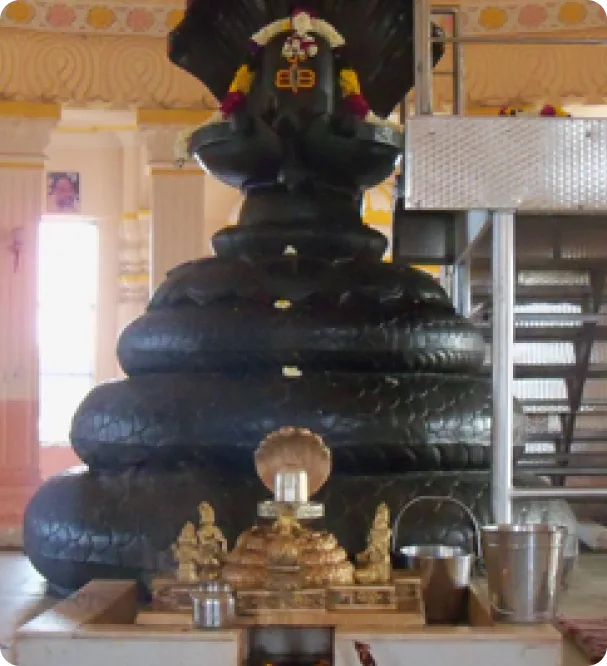
As one approaches Babaji’s Samadhi, a large, ornamental brass bell, installed in the center of the park, is visible on the right. This bell was made according to Babaji’s wishes and used approximately 3,000 kilograms of brass. Beyond this lies Babaji’s Samadhi—a grand and sober structure where Babaji’s mortal remains rest in eternal peace, directly below the Shivalinga of the Nageshwar Temple on the first floor. The Shivalinga here rests on the coils of Sheshnag, symbolizing the immortal, eternal Shakti (Lord Shiva)—transcendent and unaffected by the ever-changing and recreating movement of time. Behind and to the left of the Samadhi is the guest house where Babaji spent some time before being transferred to the Matrichhaya complex.

At this point, a brief description of the Navaratri festivals—which are celebrated twice a year at the temple—is necessary: ​​the spring Chaitra Navaratri in March–April, culminating with Rama Navami, and the Sharada Navaratri in September–October, culminating with Dussehra. To accommodate the millions of devotees who visit the temple during Navaratri, ample free parking has been provided—for scooters and bicycles in the Dharamshala parking lot, for cars behind the Samadhi and near the Markandeya Mandap, and for heavy vehicles in the open ground near the Hanuman statue. Each parking area has separate entry and exit gates to facilitate vehicular traffic.